
In this blog post I will show you how to thread a Passap Duomatic 80 knitting machine. After the step-by-step tutorial, I will share some tips on choosing yarn for machine knitting, which might be useful if you’re new to knitting machines.
Let’s thread the machine!
Where to put the yarn – in the ball holders or on the floor?
I prefer to put the yarn on the floor behind the machine. In my experience, both cones and balls feed through the machine better when they are placed on the floor. I use the ball holders to store tools while I’m knitting.
Step 1: Thread the yarn through the first eyelet on the yarn guide.
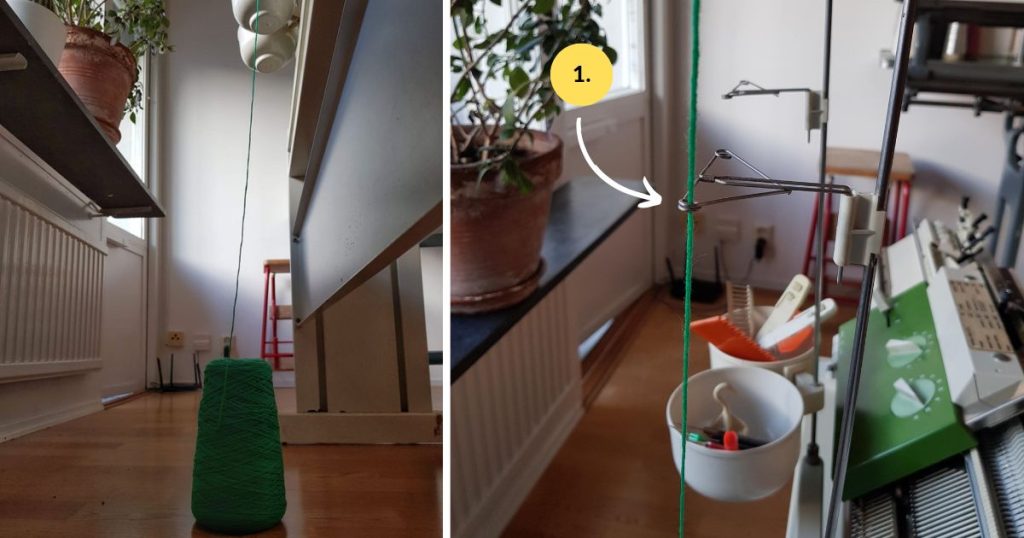
Step 2: Thread the yarn between the tension discs. Pull the outer disc away slightly, and make sure the yarn goes under the small pin on the inside disc.
Step 3: Thread the yarn through the next eyelet on the yarn guide.
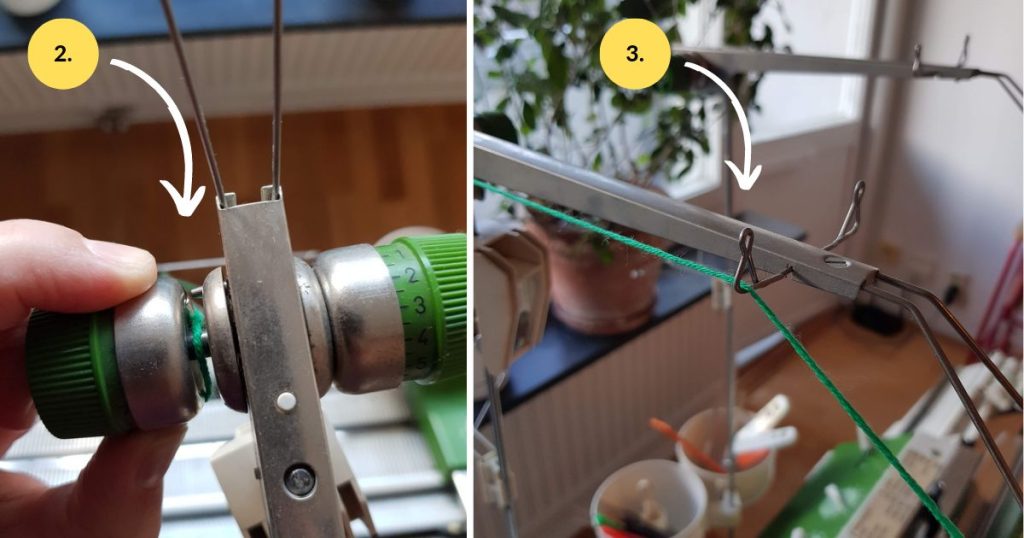
What tension for the tension discs on the yarn guide?
The tension discs are numbered from 1 to 7. Lower number = looser tension. Higher number = tighter tension. If you’re not sure, start in the middle at 3,5. This will work well for most yarns.
Step 4: Thread the yarn through the next eyelet on the yarn guide.
Step 5: Thread the yarn through the next eyelet on the yarn guide.
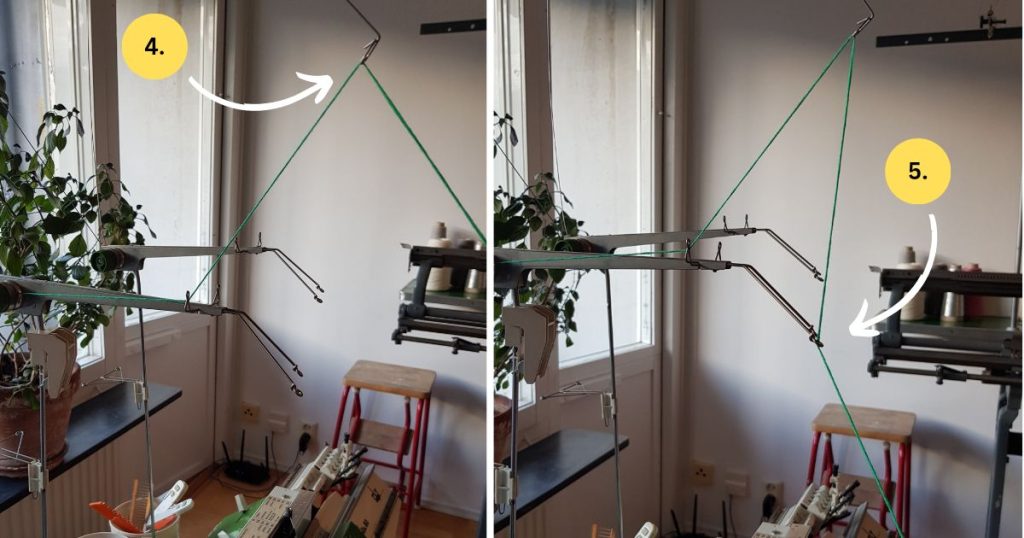
Step 6: Feed the yarn through one of the feeding eyelets. Bring the yarn in between the needle beds, and fasten it to the side of the machine.

Yarn guides and feeding eyelets
If you’re threading 2 (or more!) yarns, make sure the yarn in the yarn guide furthest to the left goes into the feeding eyelet furthest to the left. The yarn guide second from the left goes into the feeding eyelet second to the left, and so on. This is to prevent the yarns from crossing over and getting tangled up when you’re knitting.
Yarn on cones, or balls of yarn – what’s best for machine knitting?
If you can get hold of yarn on cones, that’s usually the best option for machine knitting. Yarn on cone tends to feed through the machine more smoothly than balls of yarn, which is important to ensure that the machine can form stitches correctly. Another reason to buy yarn on cones is that it is usually more economical: the price per gram is usually a little bit lower than if you’re buying balls of yarn.
However, you might already have balls of yarn that you really want to use for machine knitting. Just make sure they are wound carefully, so the yarn can flow freely through the machine. If possible, use a wool-winder to wind a neat ball of yarn, and run the yarn from the centre of the ball when you thread the machine.
Do you have to wax the yarn?
The Passap Duomatic 80 manual recommends using a piece of paraffin to wax the yarn before knitting. This is to help the yarn flow freely and smoothly through the machine.
I do not wax my yarn before knitting. I have used all sorts of yarn qualities in my machine – merino wool, cotton, viscose, cashmere, mohair, lycra, etc. – and have never had any issues.
‘Greasy’ or oily yarn on cone – what’s that?
If you buy yarn on a cone it is often sold ‘greasy’, with oil from manufacturing left in the yarn. Greasy yarn is great for machine knitting, as the oil will help the yarn flow smoothly through the machine. Here are two examples of greasy/oily yarns that work well for Passap knitting machines: Holst Supersoft (Denmark) and JC Rennie Supersoft (UK). You can read more about greasy yarn on the JC Rennie website: Greasy or clean?
Hope you found this tutorial useful. Check out my blog for more posts about machine knitting. If you have any questions about Passap knitting machines, feel free to leave a comment below and I will do my best to help!
Leave a Reply